

Disclaimer: This article was lovingly written by me truly, with no AI involved in the writing process. However, I did get a (huge) helping hand from AI to create the exercises—but don’t worry, I kept a close eye on everything! 😉
Ciao! 👋
Today I would like to talk about ( another 🙄) common doubt for beginners (even though I have to admit that even some intermediates still don’t have the difference clear): when to use  and when to use
  ?
?
You will find it very useful to understand this difference, at least in broad terms,, because we use these two verbs a lot in everyday life.
And since your goal is to learn to say what you want in Italian, this short article will help you do so more confidently.
Said that, cominciamo (let’s get started)! 💪
Indice dei contenuti
Il verbo “essere”
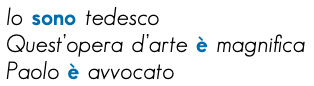
The verb is one of the most important verbs in Italian. We use it to talk about existence and characteristics of people or things. Also to talk about nationality, profession, or marital status of a person:
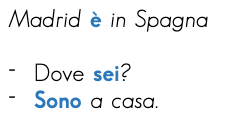
It is also used to locate someone or something:
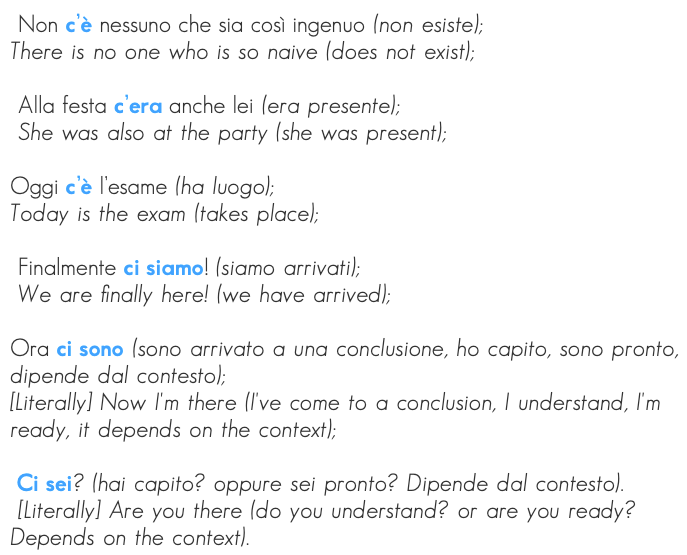
Together with the particle ci here it means to exist,to be present,to take place; to have arrived.
Other uses of “essere”
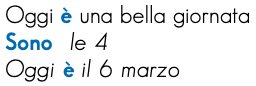
Also to talk about the weather, the time, the date, or to indicate membership in a group is used :
Il verbo “stare”

To express a temporary physical and psychological condition, replacing the verb sentire (to feel) and is used with an adverb

The verb , on the other hand, is used to indicate the position as a synonym for restare, rimanere (to stay, to remain) as in the first example, or the temporary condition of a person or thing (in the second):

It is also used to indicate ongoing action, now in te presente as in:

It is also used to indicate an action that began at an unspecified time in the past, is continuing now and will continue in the future without a definite time:

Altri usi di “stare”
If you stay in one place for a long time, we’ll use :

(Here, the meaning is figurative, but the essence is this: I want to stay in this “place” for a long time)
It can also be used to describe a person’s habitual behavior:

Common Uses of “Essere” and “Stare”
To better understand the difference between the two verbs, here are some examples of common usage:

In the first sentence there is the verb because I describe a (permanent) quality, but in the second one I use because “on you, that hat looks good” (on another person I don’t know).
Attenzione‼️
In Italian I can say:  by using the verb to express a state of mind right now, but I will use to ask someone to pass, by engaging in doing so, for eg., from a state of agitation to a calm one .


(I ask you to stop moving around so much, again a “transition of status“)
I hope that after reading this article the difference between an d is clearer.
In case you want to “field test” this aspect of the Italian language, I leave you the link to do it with me(with this link, if you upload at least $20 to the wallet of  you’ll get $10 free😉)
PDF Summary Table & Exercises
I often read interesting articles that I already know I would like to re-read later and after a few days, so I print it out or put it on my Ipad because I find it inconvenient to read on the computer. If maybe you do too, I’ll leave you the PDF Summary Table of this article and a couple of exercises (with solutions), in case you want to put the “essere” and “stare” into practice a bit.
http://parliamoitaliano.altervista.org/essere-o-stare/
https://aulalingue.scuola.zanichelli.it/benvenuti/2020/02/27/test-68-essere-o-stare/
https://www.italianoinonda.net/e156.
https://www.cdl-edizioni.com/attivita/a1/a1-verbi/attivita-1-presente-indicativo-stare/
https://wordwall.net/it-it/community/essere-o-stare
Alla prossima! 👋
(See you next time)

 Dillo in Italiano