
Disclaimer: This article was lovingly written by me truly, with no AI involved in the writing process. However, I did get a (huge) helping hand from AI to create the exercises—but don’t worry, I kept a close eye on everything! 😉
Ciao!👋
Today I would like to talk about the verb “potere”, that is one of the most used modal verbs in Italian and indicates the possibility or ability to do something. In English, it corresponds to the verbs “can” and “may”.
Usually, it makes confusion with the verb riuscire a (I discuss it in more detail here), but in this article I’ll just show you the meaning and usage of the verb Potere.
At the end you can download a PDF Summary Table and a quick exercise 🤩
Allora, cominciamo! 💪
- “Potere” and Its Forms
- To Express ability
- To Ask or Give Permission
- In Conditional Sentences
- Recap
- PDF Summary Table & Exercise
“Potere” and Its Forms
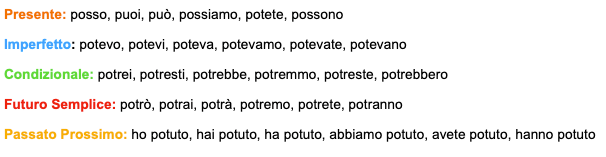
“Potere” is conjugated in various ways depending on the tense and mood.
Here are some common forms:
In the past perfect tense when to use “essere” instead of “avere”:
- “Essere” is used with “potere” when the verb is followed by a verb of movement or change of state, such as “andare”, “venire”, “partire”, “arrivare”, “diventare” etc.
- Also, “essere” is used in sentences that express an action that reflects on the subject (reflexive action: vestirsi, lavarsi, etc) or in passive constructions.
Examples:
- Sono potuto andare al concerto solo grazie a te.
(I was able to go to the concert only thanks to you.) - Sei potuto uscire prima dal lavoro?
(Were you able to leave work early?)
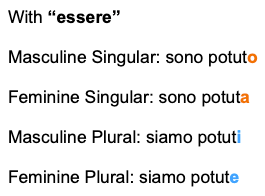
The variants of the past perfect with “essere” follow the agreement of the past participle with the subject of the sentence:
To Express ability
In Italian, “Potere” is used to talk about what one is able to do or not do.
Examples:
- Posso parlare quattro lingue.
(I can speak four languages.) - Non posso venire alla festa domani.
(I can’t come to the party tomorrow.)
In English, “can” and “cannot” (or “can’t”) are used similarly.
To Ask or Give Permission
“Potere” is often used to ask for or give permission in a formal or polite manner.
- Posso usare il tuo telefono?
(May I use your phone?) - Puoi uscire con gli amici dopo cena.
(You may go out with your friends after dinner.)
In English, “may” is more formal than “can” and is often used to give or ask for permission politely.
In Conditional Sentences
The verb “potere” is also found in conditional sentences to express hypothetical possibilities.
- Potrei studiare di più se avessi più tempo.
(I could study more if I had more time.) - Avresti potuto chiamarmi.
(You could have called me.)
In English, “could” is the past of “can” and is used to express past or conditional possibilities.
Recap
Here I just add a quick recap to help you memorise what you have just red.
Usage of “Potere”:
- To express ability:
“Posso parlare quattro lingue” (I can speak four languages). - To ask or give permission, often in a formal context:
“Posso usare il tuo telefono?” (May I use your phone?). - In conditional sentences to express hypothetical possibilities:
“Potrei studiare di più se avessi più tempo” (I could study more if I had more time).
I hope this article has been helpful , alla prossima! 👋

 Dillo in Italiano
1 pensiero su “Mastering Italian: A Comprehensive Guide to the Verb ‘Potere’”