

Ciao! 👋
Today I would like to tackle another question that my students often ask me:
when to use “Già” and when “Ormai“?
I had never truly grasped this distinction until one of my students brought it to my attention 😅
To my surprise, I uncovered that this discrepancy exists solely in Italian, unlike in Spanish or even in English.
This may seem subtle, but to us, it’s a crucial distinction.
Despite the apparent similarities, the underlying concepts are indeed different. I’m confident that with my explanation, you will internalize this distinction and be able to implement it with ease. Just imagine the impact it will have!
Then Put it into practice and witness the difference for yourself. 🙂
- When to use “Già”
- When to use “Ormai”
- The Comparison: Where they overlap
- PDF Summary table and Exercises
When to use “Già”
Già is the word of anticipation and confirmation. It focuses on the fact that something happened sooner than expected or is simply finished.
A. Anticipation (Sooner than expected)
- “Sono solo le otto e sei già qui?” (It’s only eight and you are already here? — Surprise at the speed).
- “Hai già finito i compiti? Bravissimo!” (You’ve already finished your homework? — Done faster than thought).
B. Completion (Past actions)
- “Ho già mangiato, grazie.” (I have already eaten — The action is finished).
- “Siamo già stati a Roma tre volte.” (We have already been to Rome three times).
C. Agreement (Meaning “Exactly” or “Indeed”)
In conversation, già is used as a stand-alone response to agree with someone.
- “Che bella giornata!” — “Già, è bellissima.” (“What a beautiful day!” — “Indeed, it is.”)
- “La vita è cara a Milano.” — “Già…” (“Life is expensive in Milan.” — “True / I know…”)
D. Former Roles (Meaning “Ex-“)
Used in formal contexts to describe someone’s previous position or title.
- “Il già Presidente della Repubblica.” (The former President of the Republic).
- “Il professore Rossi, già docente di Latino.” (Professor Rossi, formerly a Latin teacher).
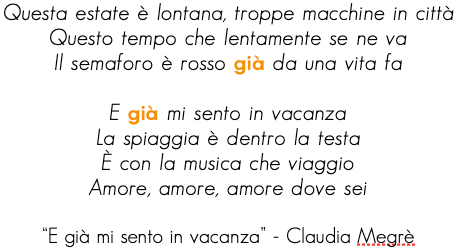
https://www.youtube.com/watch?v=MM4S0YsPafE
When to use “Ormai”
Ormai (or oramai) is the word of finality and resignation. It focuses on the fact that a situation is settled and cannot be reversed.
A. Finality (Too late to change)
- “Non correre: il treno ormai è partito.” (Don’t run: the train has already left — You can’t catch it now).
- “È inutile scusarsi, ormai il danno è fatto.” (It’s useless to apologize; the damage is already done).
B. “By now” or “Practically”
It indicates that an action is so close to being finished that it is effectively done.
- “Ho ormai finito di pulire.” (I have practically finished cleaning — Only seconds left).
- “Siamo ormai arrivati a casa.” (We have almost arrived home / We are home by now).
C. Resignation/Acceptance (“At this point”)
It suggests that since a certain point has been reached, we must accept the consequence.
- “Ormai che siamo qui, entriamo.” (Since we are already here anyway, let’s go in).
- “Inutile piangere, ormai è andata così.” (No use crying, it went that way and that’s it).
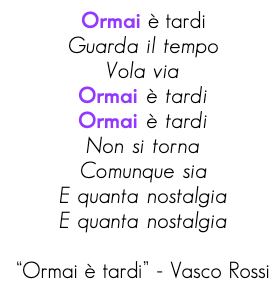
https://www.youtube.com/watch?v=S-A-a7_QJek
The Comparison: Where they overlap
In Italian, già and ormai (or oramai) often overlap when we want to indicate that a situation has ended or that it is too late to change it.
However, there is a slight difference in meaning:
Già emphasizes completeness or anticipation (something happened earlier than expected).
Ormai emphasizes irreversibility or resignation (there is no going back).
Here are some examples where you can use both:
1. When it’s too late
In these cases, both indicate that the opportunity has passed:
“Volevo salutare Marco, ma se n’è già andato.”
“Volevo salutare Marco, ma ormai se n’è andato.”
The difference: With “già” you emphasize that he left before you arrived; with “ormai” you emphasize that there is nothing you can do to see him now.
2. Established situations
These are used to describe a fact that has become a definitive reality:
“Abito qui da dieci anni, già mi sento a casa.”
“Abito qui da dieci anni, ormai mi sento a casa.”
The difference: “Già” suggests that feeling at home happened almost immediately or naturally; “ormai” suggests that so much time has passed that it couldn’t be otherwise.
3. Conclusion of a job or task
Both indicate that the action is finished:
“Non aiutarmi, ho già finito tutto.”
“Non aiutarmi, ormai ho finito tutto.”
The difference: “Già” conveys speed (I finished earlier than expected); “ormai” conveys that your help is no longer needed because the work is almost done or finished.
4. With numbers and age
When you want to emphasize an achievement:
“Ha già trent’anni, dovrebbe essere più maturo.”
“Ha ormai trent’anni, dovrebbe essere più maturo.”
The difference: “già” expresses surprise at how quickly time passes; ‘ormai’ sounds almost like “it’s too late to change,” with a more resigned or critical tone.
In wrapping up, it’s truly fascinating how seemingly small details like the usage nuances between “Già” and “Ormai” can unlock a world of understanding in Italian.
You might not have noticed this before, but once you delve into it, it’s like discovering hidden treasures within the language. It’s like finding a secret pathway that leads to a richer, more nuanced communication experience.
Think about it: while other languages might not have this distinction, Italian does, and it adds layers of depth to your expression. It’s like having access to a palette of colors that allows you to paint vivid pictures with your words 🎨
So, as you navigate between “Già” for events happening earlier than expected and “Ormai” for those irreversible moments, you’re not just mastering words; you’re mastering the art of Italian expression.
Embrace it with passion, and with every conversation, you’ll find yourself diving deeper into the beauty and complexity of the Italian language.
If you’d like, print out this list or save the page and then book a trial lesson with me to practice them a bit, how about it? 😊
Or, Try it yourself! Think about your day. Is there something you have già done (finished early) or something that is ormai part of your routine?
Let me know in the comments!
PDF Summary table and Exercises
I often read interesting articles that I already know I would like to re-read later and after a few days, so I print it out or put it on my Ipad because I find it inconvenient to read on the computer. If maybe you do too, I’ll leave you the PDF Summary Table of this article and a couple of exercises (with solutions), in case you want to put the “già” and “ormai”. into practice a bit.
Buon proseguimento nel tuo viaggio alla scoperta dell’italiano e alla prossima!! 👋
(Enjoy your journey of Italian discovery and see you next time!!!)

 Dillo in Italiano