
This article was lovingly written by me truly, with no AI involved in the writing process. However, I did get a (huge) helping hand from AI to create the exercises—but don’t worry, I kept a close eye on everything! 😉
Ciao! 👋
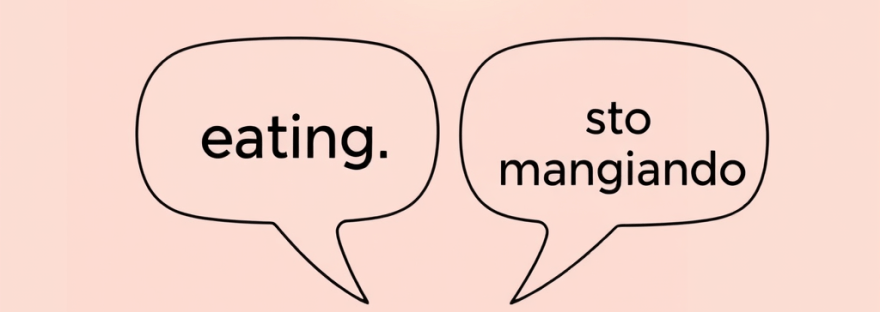
Today I would like to talk to you about something I have often noticed during my lessons with English-speaking students: the use of the present progressive tense is different from Italian, and very often the construction ‘stare + gerundio‘ does not work.
While English and Italian both possess present progressive forms, their usage patterns reveal fascinating differences that often challenge language learners. Though structurally similar—English “I am eating” and Italian “sto mangiando”—these constructions serve different communicative purposes in their respective languages.
- Future Planned Actions
- Temporary vs. Permanent Situations
- Frequency of Progressive Usage
- State Verbs and Progressive Restrictions
- Emotional and Habitual States
- Cultural and Cognitive Implications
- Practical Learning Implications
- PDF Summary Table & Exercises
Future Planned Actions
One of the most striking differences lies in expressing future planned events. English frequently employs the present progressive for scheduled future actions, while Italian typically favors the simple present or future tense.
English Examples:
- “I’m meeting Sarah at 3 PM tomorrow.” (planned appointment)
- “We’re flying to Paris next week.” (confirmed travel plans)
- “The conference is starting on Monday.” (scheduled event)
Italian Equivalents:
- “Incontro Sarah alle 3 domani.” (simple present)
- “Andiamo/Andremo a Parigi la prossima settimana.” (simple present/future)
- “La conferenza inizia lunedì.” (simple present)
This difference reflects English speakers‘ tendency to view planned future events as ongoing processes that have already begun in their minds, while Italian speakers treat them as discrete future occurrences.
Temporary vs. Permanent Situations
English makes a sharp distinction between temporary and permanent states through its progressive forms, while Italian relies more heavily on context and adverbial phrases.
English Examples:
- “I live in London” (permanent residence) vs. “I’m living in London” (temporary stay)
- “She works at the bank” (permanent job) vs. “She’s working at the bank” (temporary position)
- “He teaches mathematics” (career) vs. “He’s teaching mathematics” (temporary assignment)
Italian Approach:
- “Vivo a Londra” can mean both; context or phrases like “temporaneamente” or, ‘per il momento’ , ‘solo per 3 mesi’ clarify temporary situations
- “Lavora in banca” requires additional context to specify permanence
- “Insegna matematica” needs qualification like “per ora” (for now) for temporary situations
Italian speakers must explicitly state temporariness through adverbs or contextual clues, whereas English builds this distinction into the grammatical structure itself.
Frequency of Progressive Usage
The frequency with which each language employs progressive forms differs significantly, particularly in casual conversation.
English Preference for Progressive:
- “What are you doing?” (standard greeting)
- “I’m thinking about it.” (mental process in progress)
- “The weather is getting colder.” (gradual change)
Italian Preference for Simple Present:
- “Che fai?” (more common than “Che stai facendo?”)
- “Ci penso.” (preferred over “Ci sto pensando”)
- “Il tempo diventa / sta diventando più freddo.” (The change with ‘present progressive’ seems slower)
This pattern suggests that English speakers conceptualize more actions as ongoing processes, while Italian speakers often view them as simple states or facts.
State Verbs and Progressive Restrictions
English maintains stricter rules about which verbs can appear in progressive forms, particularly with stative verbs, while Italian shows greater flexibility.
English Restrictions:
- “I know the answer” (not *”I am knowing”)
- “She understands Italian” (not *”She is understanding”)
- “They believe in justice” (not *”They are believing”)
Italian Flexibility:
- “Sto capendo la situazione” (acceptable – “I’m understanding the situation”)
- “Sto credendo sempre di più in questo progetto” (possible – “I’m believing more and more in this project”)
- “Sto conoscendo molte persone nuove”
Italian allows progressive forms with cognitive verbs when emphasizing the gradual or ongoing nature of mental processes.
Emotional and Habitual States
The treatment of emotions and habits reveals another divergence between the languages.
English Distinctions:
- “You’re being difficult” (temporary behavior) vs. “You are difficult” (permanent trait)
- “I’m loving this book” (current enjoyment) vs. “I love books” (general preference)
- “She’s always complaining” (habitual criticism) vs. “She complains” (neutral observation)
Italian Approaches:
- “Sei difficile” typically requires adverbs like “oggi” for temporary behavior; without means ‘always’ 😅
- “Mi piace /mi sta piacendo questo libro”, with present progressive convey more engagement in this story.
- “Si lamenta sempre” conveys habitual action without progressive structure
Cultural and Cognitive Implications
Deep Cultural Patterns
These differences reflect deeper cultural and cognitive patterns in how speakers of each language process temporal information. English speakers seem to conceptualize more experiences as processes unfolding over time, while Italian speakers often view them as states or completed actions. This manifests in English’s greater willingness to “progressivize” various verb types and situations.
The Translation Challenge
Understanding these distinctions proves crucial for language learners, as direct translation often fails to capture the nuanced meanings each language conveys through its progressive structures. The key lies in recognizing that grammatical forms carry cultural perspectives about how we perceive and organize temporal experience.
Practical Learning Implications
For Italian Speakers Learning English
For Italian speakers learning English, the challenge involves expanding their use of progressive forms beyond obvious ongoing actions. They must learn to think in terms of temporary vs. permanent states and future planned actions expressed through present progressive.
For English Speakers Learning Italian
For English speakers learning Italian, the task requires recognizing when simple present forms carry meanings that would be progressive in English. They need to rely more on context and adverbial phrases rather than grammatical structure alone.
Universal Benefits
Both groups benefit from understanding that these aren’t arbitrary grammatical rules but systematic differences in how each language structures temporal and aspectual meaning. Mastering these distinctions marks a significant step toward true fluency in either language.
PDF Summary Table & Exercises
I often come across interesting articles that I know I’ll want to revisit later, so I either print them out or save them on my iPad, as I find it inconvenient to read on a computer. If you feel the same way, I’ve provided a PDF Summary Table of this article, along with an exercise (with answers) so you can practice using Italian Present Tense or ‘Stare + gerundio’.
Alla prossima! 👋

 Dillo in Italiano