

Disclaimer: This article was lovingly written by me truly, with no AI involved in the writing process. 😉
Ciao! 👋
Here we finally come to the obnoxious question that takes so many people’s sleep away:
“I will have to use  or
or  ?”. 🧐
?”. 🧐
They are two tenses that may seem similar, but they actually have significant differences and can affect communication. If you are confused about when to use one or the other, you are in the right place!
In this post, I offer you a truly comprehensive guide to discover the differences between the passato prossimo and imperfetto and learn to use them like a native speaker.
I’ve made tables and diagrams (downloadable) to make everything easier and more intuitive, so you can figure out on the fly what situations to use one or the other and when to use them together!
Ready to become experts on these two tenses?
Let’s get started!
- Habitual vs. Punctual actions
- Lasting action vs. Short action
- Describe vs. Keep the story going
- Indeterminate vs. Precise repetition
- Simultaneous events vs. Events in succession
- Defined time
- Two simultaneous actions
- Summary PDF Table
🤩 A little trick: to help you create the automatic mechanism of when to use the passato prossimo and when the imperfetto remember that:
The choice of tense always depends on the situation, NOT on the type of verb.
Think about the question:
“WHAT SITUATION DO I WANT TO DESCRIBE?” 🧐
Based on that you choose the time.
Habitual vs. Punctual actions
The is used for habitual actions in the indefinite past, such as classical phrase:
“Da bambino/a andavo al mare dai nonni”.
(“As a child, I used to go to the seaside to my grandparents.”)
The Instead, we use it for a specific time:
“Una settimana fa sono andata/o a Monaco”
(“A week ago I went to Munich.”)

Lasting action vs. Short action
For enduring or continuous action, which however we do not know how long it lasted, we use :
“Ero fuori a passeggiare”
(“I was out walking.“)
🤫 Did you know that…🧐
Did you know that if you break down the word “Imperfetto” into “im-perfetto“, it means “not perfect“?
Consequently, it is used for all those “imperfect“, “indefinite” situations. 😉
For momentary actions that happened in a moment, the is used as in:
“Ha suonato il telefono”
( “The phone rang“)

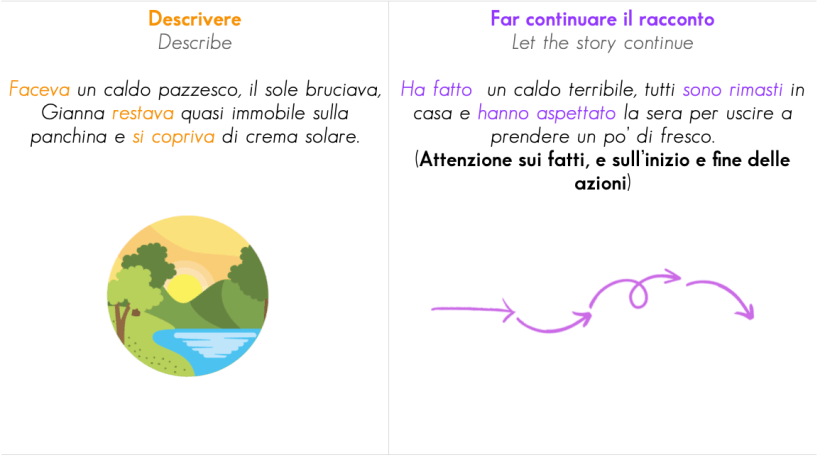
Describe vs. Keep the story going
As I always tell my students, imagine a movie: who carries the story forward, who makes the events happen? The actors. In this somewhat peculiar film instead, pretend that the actor is the because it is through him that events happen and the story becomes interesting:
“Il ladro è saltato giù dalla finestra”
(“The thief jumped out of the window”)
“La polizia l’ha cercato per ore”
(“Police searched him for hours”)
For the scene or the setting of the film, we will need the to describe the background:
“C’era il sole”
(“There was the sun”)
“Le persone passeggiavano in riva al fiume”
(“People were walking along the riverbank”)
Indeterminate vs. Precise repetition
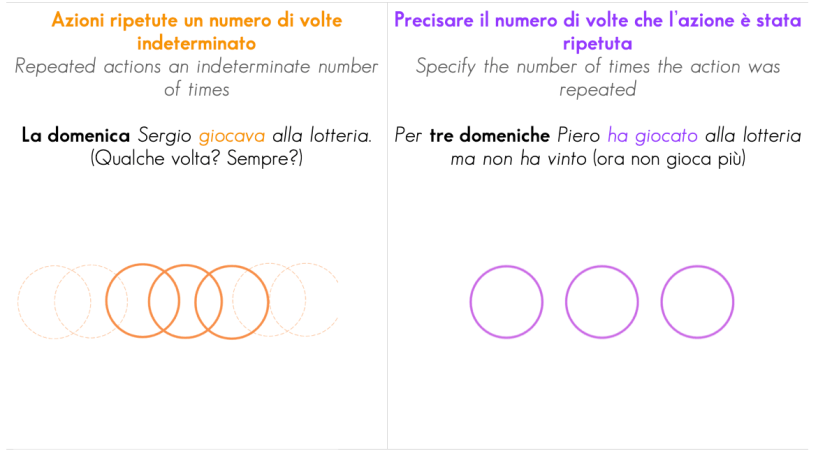
The use I now describe of the is just a clarification in that it is very similar to a past habit, but we are actually focusing on not knowing how many times the action has been done:
“Il giovedì mattina andavo in piscina” (Tutti i giovedì mattina?)
“On Thursday mornings I used to go to the pool” (Every Thursday morning?).
The is “the stickler” of the pair, so we need it to specify how many times something happened:
“Per 2 giovedì sono andato in piscina” (poi ho smesso)
“For 2 Thursdays I went to the pool” (then I stopped).
Simultaneous events vs. Events in succession
To talk about events that happen all at the same time or in the same period, we use the present perfect tense because the important thing is not so much when, but how many actions have been done:
“Da adolescente suonavo il pianoforte, sciavo e recitavo“
(“As a teenager, I played the piano, skied, and acted“)
If instead the actions were not simultaneous, but when one ended the other began, we use the image:
“Quando ero adolescente ho suonato il pianoforte, ho imparato a sciare e poi ho studiato recitazione”
( “When I was a teenager, I played the piano, learned to ski, and then studied acting”)

Defined time
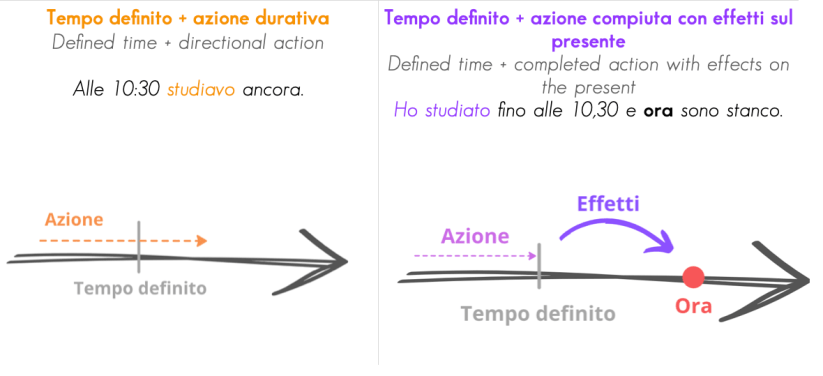
This is the case that creates the most confusion because in both cases there is a defined time, but in one we use the imperfect and in the other the passato prossimo.
In this case, it depends on what happened: if the action continues beyond “the time” without thinking about the consequences, it will be descriptive, so we will have to use the:
“A mezzogiorno ero ancora imbottigliato nel traffico“
(“At noon I was still stuck in traffic.”)
If we want to describe the consequences of an action terminated at precisely that time, we will use the:
“Ho ballato fino alle 2 e ora sono stanchissimo/a”
(“I danced until 2 o’clock and now I’m so tired.”)
Two simultaneous actions
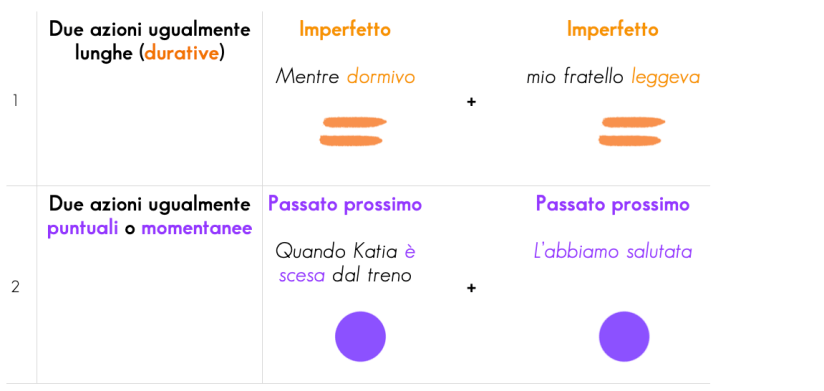
For this category there are 3 cases:
- Two durative actions, so for both we will use the :
Mentre correvo ascoltavo un TedEx Talk”
(“I was running while I was listening to a TedEx Talk”)
- Two immediate actions, for which we have our lovely
Ho fatto un incidente e ho subito chiamato la polizia
(“I had an accident and immediately called the police”)
- A durative and a momentary action, where, as you may have understood by now, the former will require the and the latter the :
“Passeggiavo in riva al mare, quando mi ha chiamato Anna per dirmi che non sarebbe venuta al matrimonio”
(“I was walking along the seashore when Anna called me to tell me she wasn’t coming to the wedding.”)

Summary PDF Table
Well, that’s it for this one!
I often come across interesting articles that I know I’ll want to revisit later, so I either print them out or save them on my iPad, as I find it inconvenient to read on a computer. If you feel the same way, I’ve provided a PDF version of this article, so you can practice using “passato prossimo” and “imperfetto”.
I hope as always that this post has been helpful to you, and if you want to practice a bit of Italian with me, or if you have any further questions or feedbacks, I’ll leave you the link to my profile on Italki .🤗
Alla prossima! 👋

 Dillo in Italiano
1 pensiero su “Passato Prossimo vs Imperfetto: The Key to Speaking Italian Like a Native”