

Disclaimer: This article was lovingly written by me truly, with no AI involved in the writing process. However, I did get a (huge) helping hand from AI to create the exercises—but don’t worry, I kept a close eye on everything! 😉
Ciao! 👋
Are you ready to discover the differences between the usage of the word “good” in English and the words “bene“, “bravo“, and “buono” in Italian?
I know it may be a bit confusing, but I’m here to help you understand which word to use based on the context. In this article, I will show you the differences between these words in a simple and clear way.
I will also provide examples to demonstrate how to use them correctly.
So, if you want to communicate effectively and without errors, keep reading!
Good Vs. Bello
It is the simplest because:

👉 It indicates the aesthetic aspect of someone or something. It is an adjective and, as you know, we must agree both in gender and number with the person or object it refers to.
Its contrary is brutto.
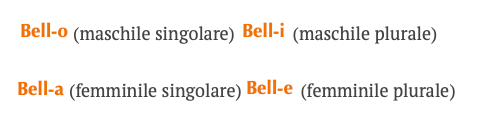

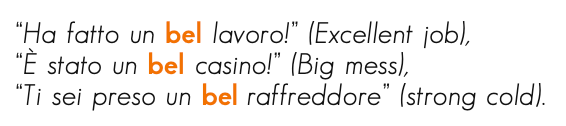
👉 Bello is also used to intensify a concept, both in a positive and negative sense.
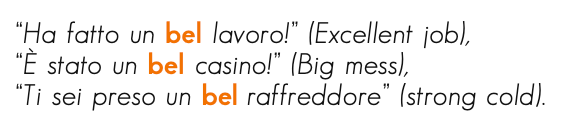
👉 Bello can also be used in an ironic way, to express the opposite of what is said.
Good Vs. Buono

👉 Buono in Italian is used to describe the positive quality of an object or an experience.
Its contrary is “cattivo“.
As for Bello, we need to agree on gender and number, so we have:
 (maschile singolare)
  (maschile plurale)
 (femminile singolare)
  (femminile plurale)
👉 If we use it to refer to people, we mean that they are kind, not aggressive.

👉 In fact, if we use it to refer to an object, it means that it has good taste or good quality.

👉 It is also used to emphasize a concept, usually with numerals or expressions of time.

👉 To wish something to someone, and, as seen in the examples, if it comes before the noun, “Buono” loses the “o” and becomes “Buon“.

Good Vs. Bravo

The Italian word “bravo” can be used to translate “good” in English, but it has a slightly different meaning.
As always, we have four forms for each gender and number:
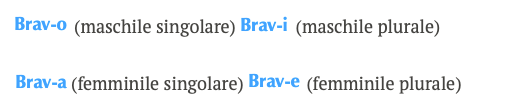
👉 “Bravo” in Italian is used to describe a person (not an object) who has competence or skill in a certain field.

👉 As you can see, it can also be used to express appreciation for something someone has done well something.
👉 It is also used to refer to an honest, good-natured, or well-behaved person. The opposite is “cattivo“.
 .
.
❗️ At first glance, this expression seems quite similar to :
 , but it’s not.
Or rather, the difference is subtle.
The first one means that Jack follows the rules and acts correctly.
The second implies that Jack is a kind of dog that doesn’t hurt anyone, gentle.
👉 It can also be used ironically, to express the opposite of what is being said, that is, criticism, disapproval, reproach, or mockery.

Bravo and prepositions
For this adjective, it would be useful to delve into the use of Bravo + prepositions:
👉 
Indicates that a person is knowledgeable and skilled in a subject or discipline.

👉 
With infinite verb:

👉 
Used with objects and persons:

Good Vs. Bene

One of the most common Italian words that can be used to translate “good” into English is “bene“. However, these words are not always interchangeable.
👉 Bene is used to describe the way something is done, and not the object itself. For example:

👉 In other words, specify the manner of the verb, not that of the noun.

In this case, “bene” refers to the verb “cucinare” (as in the example above “è cucinato“) and can be used as an adverb to describe how something is done.
If I want to say that someone is good at doing something, I will use the adjective “bravo/a/e/i”.

As we have seen before.
Here we are at the end. I hope that now the difference between these various forms is clearer! It wasn’t that complicated, right?
Write me a message if you have any questions or if you want to practice Italian and start speaking like a native speaker!
PDF Summary Table and Exercises
I often read interesting articles that I already know I would like to re-read later and after a few days, so I print it out or put it on my Ipad because I find it inconvenient to read on the computer.
If maybe you do too, I’ll leave you the PDF Summary Table of this article and a couple of exercises (with solutions), in case you want to put the Difference between ‘bene’, ‘bravo‘ and ‘bello‘ into practice a bit.
Alla prossima! 👋

 Dillo in Italiano
1 pensiero su “Understanding the Differences: Good Vs. Bello, Buono, Bravo in Italian”