

Disclaimer: This article was lovingly written by me truly, with no AI involved in the writing process. However, I did get a (huge) helping hand from AI to create the exercises—but don’t worry, I kept a close eye on everything! 😉
Ciao! 👋
In this post, I would like to talk to you about one of the most famous doubts among those who study Italian: when should I use  and when
  ?
?
The answer is very simple, you should only change the point of view, focusing on the verb:
If the verb is followed by the prepositions  ,
, ,
, ,
, you will have to use the ;
if it is followed by the preposition  or
or  it can be replaced with .
Is that all? Yes, or rather, almost…
Keep reading and I’ll explain it better.
CI
C’è, ci sono
In this case indicates the existence or presence of something or a person.

Ci moto a luogo o stato in luogo
When we need to replace a previously known place we are heading to or where we are, we use the
📌 It is often used with the verbs andare (to go), venire (to come) e stare (to stay)

( is the preposition we use when we go to people, do you remember? It’s a kind of “motion to a person” towards someone.)

But it transforms when the information is already known, so if you already know that I’m going to my grandma’s on Sunday, I can ask you:

(Literally: “What time you said that THERE you go?)
Ci per oggetto diretto o indiretto con il “noi”
Perfect, they are identical for the noi (us) with both direct or indirect object:

Ci con i verbi riflessivi per “noi”
For reflexive verbs of noi (us):

Ci con i verbi che hanno le preposizioni A, IN , CON e SU
Attention❗️
We use the when the topic, thing, or person we are talking about is already known!
Here is the list of the most common verbs that you can encounter and that can be replaced by
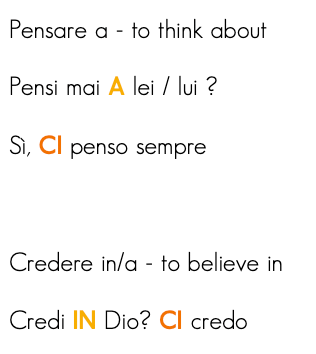
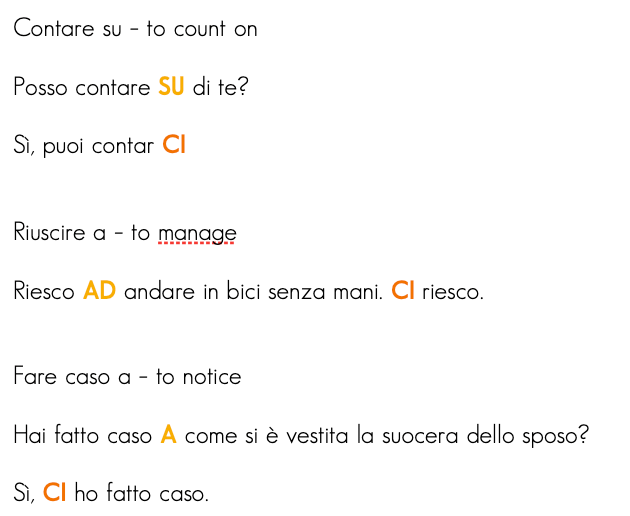
📌 Tiny clarification about spoken Italian: what you find written here (and also elsewhere) is the grammatical rule, but in everyday life, when we speak, it often happens that we place the particle before saying the verb.
In the case of the last sentence, the most natural version would be:
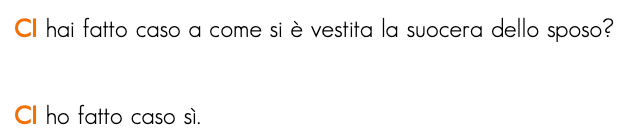
Why does this happen? Only to give more importance , to emphasize the fact that what we are about to say is very important, worthy of attention.
Well, we now turn to the infamous 
NE
The specific relevant content for this request, if necessary, delimited with characters: Like the , also the is used when the topic is already known or for quantity, as we will see now.
Ne partitivo
Indicate a quantity, or a part of a whole.
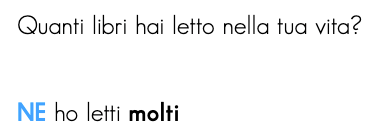
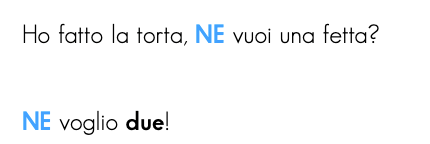
Note that if you wanted to eat it all you would say, with the direct pronoun:

Ne che sostituisce la preposizione DI
The most common verbs are: parlare , discutere (to talk about, to discuss)

Essere sicuro / a (be sure of)

Ho bisogno (I need)

Probably, on this journey of yours to discover Italian, you have come across or will come across the “Ce n’è, ce ne sono”. In English always translated as “there is, there are“, but in Italian it has a difference, let’s see:
The difference is always the same.
If I say a new information, I’ll use C’è, ci sono :

When the information is now known and this information concerns a quantity, I will use ce n’è, ce ne sono:

Ne che sostituisce la preposizione DA (moto da luogo)
Replacing the preposition (motion from place)

= dallo studio (Uscire – to go out FROM)

(Andarsene = andare via questo posto / to go away FROM this place)
📌 replaces onlyor (so, as you see, it “completes” the prepositions that the doesn’t cover)
Practical tip
One of the effective ways to be able to remember which preposition you need is to always watch out for the most common combinations (such as the ones I’ve listed for you), so you can make sure your survival level 😂.
In this way, it will seem more and more natural for you to say “ penso“, and when “ vengo” slips out of you, you will “feel” that there is something wrong 🧐
PDF Summary table & Exercises
I often read interesting articles that I already know I would like to re-read later and after a few days, so I print it out or put it on my Ipad because I find it inconvenient to read on the computer. If maybe you do too, I’ll leave you the PDF Summary Table of this article and a couple of exercises (with solutions), in case you want to put the “ci” and “ne”. into practice a bit.
https://www.impariamoitaliano.com/particelle_ci_e_ne.htm
Alla prossima! 👋

 Dillo in Italiano
1 pensiero su “Italian Made Easy: Practical Tips to Master ‘CI’ and ‘NE’”