

Ciao! 👋
Are you an enthusiast of the beautiful Italian language? Well, then understanding this to improve your Italian will be critical to your journey!
If you are, then you know that learning to inquire about the duration of an action is an essential skill.
Today will be a short, but hopefully, effective article to understand something very different between Italian and English (but also in Spanish), we’ll explore the question “How long have you been doing something?” in Italian.
But let’s see it now!
The Basics: Understanding the Question
In Italian, the phrase “How long have you been doing something?” translates to
“Da quanto tempo fai qualcosa?”
To break it down: translates to “How long” in English.
“Fai” is the present second person singular form of the verb “fare,” which means “to do” or “to make.”
“Qualcosa” means “something.”
Present Tense in Time Queries
As you see, in Italian the present tense is employed, adding simplicity to the language’s temporal expressions.
To make you understand, it’s as if we take a picture of the current state of things , we don’t look at the duration or the process itself, unlike English, which utilises the present perfect tense for such inquiries.
Let’s see some examples:
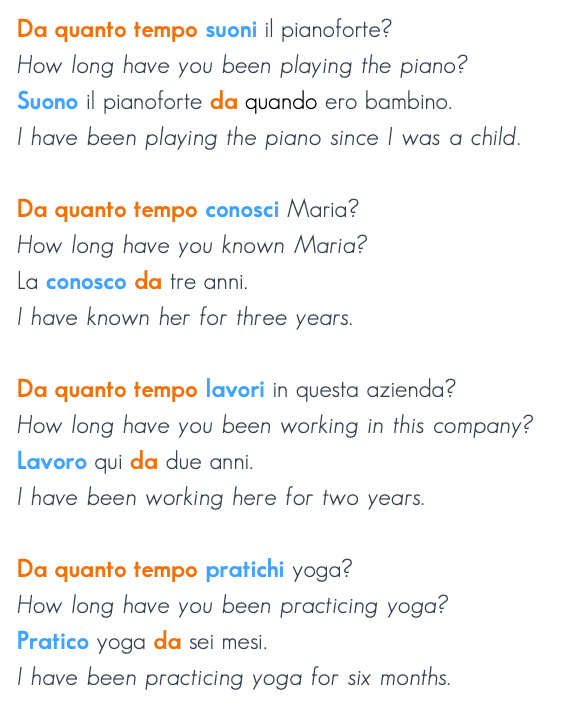
You see, it is just like a photograph 📸, it’s like saying:
“thus far it is this amount of time that…”
You see, it’s just a matter of perspective. That’s the great thing about learning languages: getting out of your comfort zone and expressing yourself in ways you couldn’t in your native language. What magic, right?
As always, it’s just a matter of habit, and to ensure that this new neural connection is made or strengthened, I leave you with a small downloadable translation exercise.
Then, if you would like to practice it by talking with me, I leave you this link to do it for practically free.
Alla prossima! 👋
(See you next time)

 Dillo in Italiano