

Ciao! 👋
Learning a new language can be a thrilling adventure, and when it comes to Italian, you’ll discover a world of rich culture and history.
While English and Italian share some similarities, there are unique nuances that set them apart. One such distinction lies in the use of the word “ancora.” In this article, we’ll explore how this seemingly simple word can make a big difference when you’re learning Italian as a beginner.
As a beginner, you’re likely discovering that while some English words have direct Italian equivalents, others require a more nuanced understanding.
“Ancora” falls into the latter category, serving as a versatile linguistic tool that can convey various meanings depending on the context. By mastering its applications, you’ll not only enhance your Italian vocabulary but also express yourself more precisely in your interactions.
In this article, we’ll walk you through five distinct ways in which “ancora” can be wielded in Italian, drawing comparisons to how similar ideas are expressed in English.
So, whether you’re just starting your Italian language journey or looking to expand your language skills, let’s set sail into the captivating world of “ancora.”
Buon viaggio! (Have a great journey!)
Still
In English, we often use  to indicate that something is ongoing or hasn’t happened yet. In Italian, you can achieve the same effect using
  .
.

Again
When you want to express the idea of doing something once more, can replace  in English.
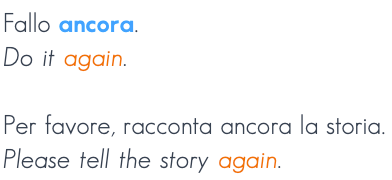
In this case, ancora can be replaced by its synonym,  .
.

More
In Italian, can be used to mean  when you’re talking about quantities or numbers.

Non…ancora as Not Yet
In Italian, you can create the equivalent of not yet by using  (not) followed by .
This combination indicates that something hasn’t happened or been completed up to the present moment.
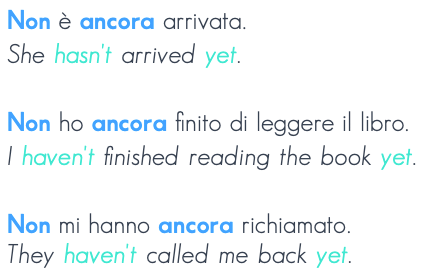
Even
In Italian, can be used to express  in certain contexts, especially when emphasizing the surprising or unexpected nature of something.
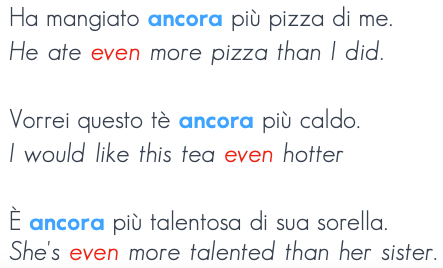
Learning how to use effectively in Italian can elevate your language skills and help you express yourself more precisely. So, as you embark on your Italian language journey, remember to anchor ‘ancora’ in your vocabulary toolkit to make a real difference in your conversations.
Buona fortuna! (Good luck!)
Would you like to practice and other aspects of the Italian language with me? You can do so for (almost) no cost by clicking on this link.
Let’s boost your Italian skills together!
Alla prossima! 👋
(See you next time!)

 Dillo in Italiano