
Disclaimer: This article was lovingly written by me truly, with no AI involved in the writing process. However, I did get a (huge) helping hand from AI to create the exercises—but don’t worry, I kept a close eye on everything! 😉
Ciao and welcome to this new article! 👋
Have you ever had difficulty understanding the difference between the words  and
and  ? Yes, I know, it may seem trivial, but it’s not so obvious after all.
Often we Italians find ourselves using these two words interchangeably without even realizing it, and those, like you, who are traveling to discover Italian ask me:
“Cristina, is there a difference between the two? Because yesterday I listened to this podcast where there was a discussion and I heard both “forse non ho capito bene” and “magari non ho capito bene”“…
Yes, unfortunately there is a difference. And as often happens, the difference is subtle. What can we do, we like nuances! 🤷♀️
They express the same concept only in one case, but in other cases, it’s not like that!
Continue reading if you want to discover all the differences between these two words.
The Four Meanings of Magari

When we talk about , we often refer to a situation that could happen, but is not certain.
But did you know that this word has two other meanings? In particular, can be used as an expression of desire, like  (I would like) or
  (if).
(if).
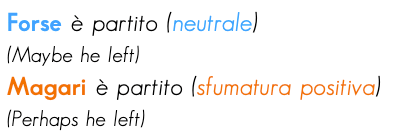
Magari = Forse
While has a neutral connotation, implies a sense of excitement and hope (it comes from the ancient Greek “makarios” which means “positive”, “happy”). If you use it instead of , you are enthusiastic about this possibility, you want it to happen.
Magari = Vorrei
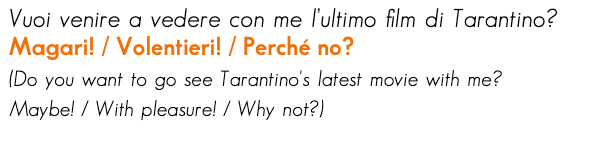
 means (I would like) when used as an exclamation in a response.
For example, if a friend asks you if you want to go for a drink in the city center and your reaction is positive, you could say:
“ Certo! Perché no?” (“Maybe! Of course! Why not?” )
In this case, the word can be replaced by the adverb “volentieri”, which means “with pleasure.”
Magari = Mi piacerebbe
, it is used as an exclamation in a response even when one wants to say that I really wish to know how to do or make something but still can’t.

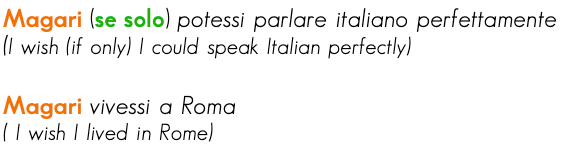
Magari = Se solo
means (“if” with a positive connotation, expressing desire) in a sentence followed by the imperfect subjunctive (😮💨 the one with double “s” – avessi, fossi, vivessi, etc).
Replace ‘Forse’ with ‘Magari’

Yes. It is possible to use instead of .
and are interchangeable when maybe is used with the indicative.
Keep in mind that the message you convey will be slightly different if you use one or the other. Remember that is always positive, while is neutral.
The choice between the two depends on the context and the tone you want to convey in the sentence.
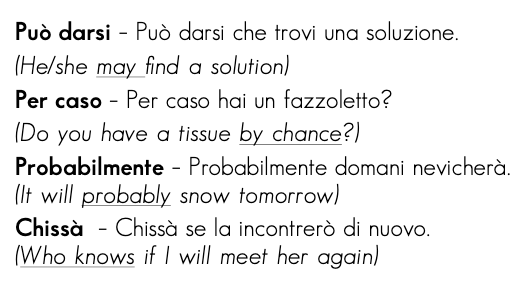
Other Ways to Say ‘Forse’
Other ways to say :
Conclusion
With these four meanings, magari proves to be one of Italian’s most expressive and versatile words. From adding positivity to a “maybe” statement to expressing heartfelt desire, each use of magari brings its own emotional tone. By incorporating magari into your Italian, you can convey more subtle emotions and deepen your communication. Try using it in different contexts, and you’ll soon see how this simple word can add color and warmth to your conversations.
Buon lavoro e… magari diventerai fluent in no time! 😉
As always, I hope that this article has been helpful to you.
There are no exercises for this article because it is something you have to practice speaking. If you want to do this with me, write me a message, or check out my Italki profile.
Alla prossima! 👋
I often come across interesting articles that I know I want to re-read later, so I print them out or save them to my iPad because I find it inconvenient to read on the computer.
If you feel the same way, I provide a PDF version of this article.

 Dillo in Italiano