

Ciao! 👋
Learning Italian can be both exciting and challenging, especially when you encounter those tricky grammar rules.
If you’re on your journey to mastering Italian, you’ve probably stumbled upon reflexive verbs.
Don’t worry, I’m here to help unravel this linguistic mystery in a friendly, straightforward way.
So, grab your espresso ☕️, and let’s dive into the world of Italian reflexive verbs! 💪
- What Are Reflexive Verbs?
- Forming Reflexive Verbs in Italian
- Ten Fundamental Italian Reflexive verbs
- Exercises
What Are Reflexive Verbs?
Reflexive verbs are a unique feature in Italian (and other Romance languages) that indicate that the subject of the sentence is performing the action on themselves. Think of them as those actions we do to ourselves, like getting dressed, washing our hands, or even enjoying a nice meal.
In Italian, reflexive verbs are easy to spot because they always end in “si.”
They’re like the chameleons of the language, adapting to the subject of the sentence.
Now, let’s explore how to form them, see some fundamental reflexive verbs and provide examples to get you started.
Forming Reflexive Verbs in Italian
Now that we’ve familiarized ourselves with some common reflexive verbs, it’s time to understand how to form them correctly. Fear not, as we’ll walk you through it step by step.
Identify the Reflexive verb
As I said, you need to recognize that you’re dealing with a reflexive verb.
These verbs always end in “si” in their basic form.
For example, “lavarsi” (to wash oneself), “vestirsi” (to get dressed), or “svegliarsi” (to wake up).
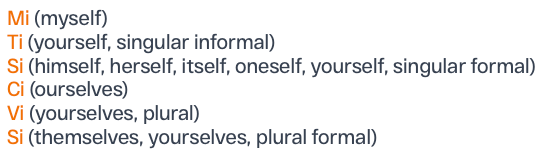
Choose the Reflexive Pronoun
The reflexive pronoun you use depends on the subject of the sentence. Here are the reflexive pronouns for reference:
Conjugate the Verb
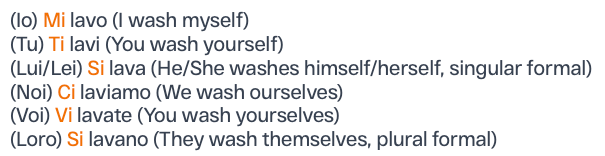
The next step is to conjugate it, but it is very simple because you just take the particle “si” at the end of the verb, put it in front of it and conjugate it to the person on whom the action falls.
Here’s a quick overview using the verb “lavarsi” (to wash oneself) as an example:
Pay Attention to Verb Tenses
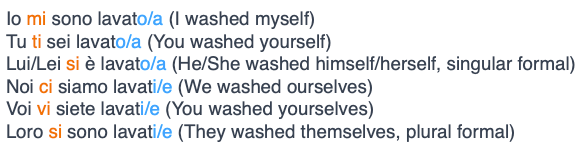
Reflexive verbs can be used in various tenses, such as present, past, or future. You’ll need to conjugate them accordingly while keeping in mind that it must agree with the subject in gender and number.
For example, in the past tense called “passato prossimo“:
Ten Fundamental Italian Reflexive verbs
Now, let’s explore some fundamental reflexive verbs and provide examples to get you started. 💪
1. Lavarsi (To Wash Oneself)

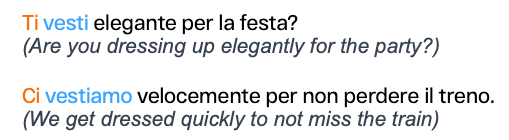
2. Vestirsi (To Get Dressed)
3. Svegliarsi (To Wake Up)
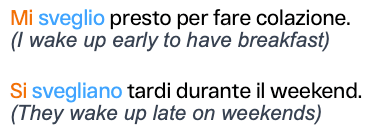
4. Alzarsi (To Get Up)
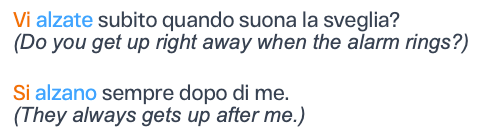
5. Mettersi (To Put On)
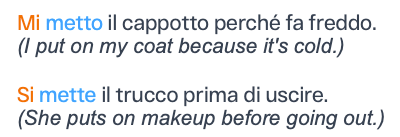
6. Addormentarsi (To Fall Asleep)
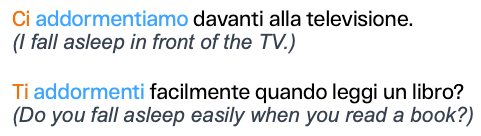
7. Divertirsi (To Have Fun)
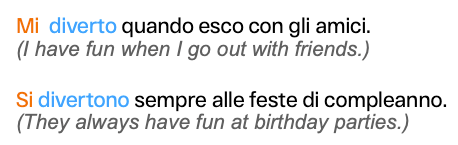
8. Preoccuparsi (To Worry)
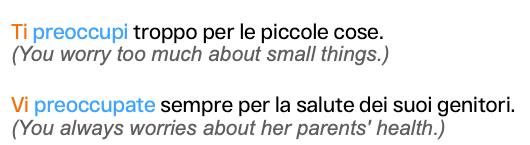
9. Chiamarsi (My name is)
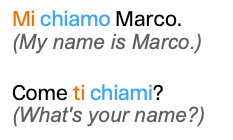
10. Sbrigarsi (To Hurry Up)
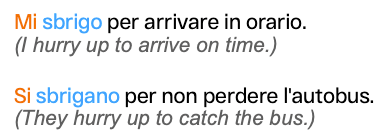
These are ten fundamental Italian reflexive verbs to kickstart your journey. Remember, practice makes perfect, so don’t hesitate to use them in your everyday conversations or, if you want, in a trial lesson with me .
With time, you’ll master these verbs like a true Italian pro. 💪
Exercises
Well, if after this explanation you feel like doing some exercises, I’ll leave you with some links.
http://www.impariamoitaliano.com/verbi_riflessivi.htm
https://www.adgblog.it/2022/09/21/i-verbi-riflessivi-al-presente-indicativo/
https://www.adgblog.it/2022/10/03/i-verbi-riflessivi-al-passato-prossimo-con-esercizi/
If you have any questions about this or other things, don’t hesitate to contact me or to book a trial lesson!
Buon viaggio nella lingua italiana!
(Happy journey into the Italian language)!

 Dillo in Italiano