

If you want to change language to the article click on “Select your language” on the right side of the screen if you’re on desktop or at the bottom of the page if you’re on tablet or mobile.
Ciao! 👋
Today I would like to talk about a frequent question that I am asked by some slightly more observant students:
“But why do you always say ce l’ho?”
” And how should I use the verb avercela without getting confused?”
I usually answer the first question by saying that we Italians need particles that tie the speech together, otherwise we get lost because we have short memories 😂
Actually, only the first part is true.
To the second I answer that there is a trick that will no longer make you confuse between the two forms. And it’s not just the context.
Read on to find out!👇
Ce l’ho
To be really specific, the particle  , which turns into ce because it is a combined pronoun in this case, has no specific function.
Probably the usage came about to improve the sound and perhaps sound less direct than just responding with “l’ho” to a question
We didn’t know what to put in and put in the much “beloved” 😂
But, to your delight, the combination  exactly matches the English
I have it.
There is only to break the habit of responding by translating from English with the form “Yes, I do” .
Italian is more discursive than English and to answer  with would be too strange.
To start thinking in Italian, you should think of your answer “Yes, i have it/them”, this way, for example:

Let’s say that we would understand what you are referring to even without the ci (of course, I just asked you!), but this particle makes everything more catchy, because there really would be no need for it.
This rule applies whenever the verb avere is preceded by a direct object pronoun (e.g. lo, la, li, le). Therefore, the phrases e  indicate whether you own something or not.
Another way to describe it to you is that in English you use the auxiliary to answer, in Italian the verb avere, which is repeated in the answer:


Below is the table with conjugation for all persons:

Avercela
There, now you will say: how do I know when to use e when  ? They are identical!
Simple!
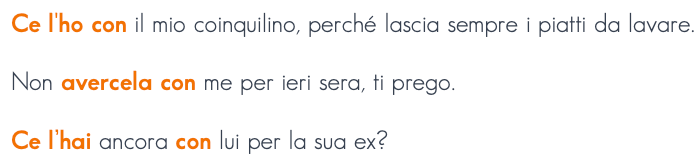
In this case the trick is that there is the preposition  that solves the problem!
Besides the much more upset context, sure 😅
The informal Italian expression “Ce l’ho con qualcuno” means “Sono arrabbiato o sono arrabbiata con qualcuno” (I’m angry or upset with someone.).
Last but not least, I remind you that the particle has other functions, which I have elaborated on in this article (as opposed to  ).
).
As always, I hope this article has clarified for you once and for all the difference between and .
One more step in your journey of Italian discovery!
✅ Done!
If you’d like to book a trial lesson, to practice the or anything else, I’ll leave you the link with which you can do it for almost for free!
See you next time! 👋

 Dillo in Italiano
1 pensiero su “Never Confused Again: The Ultimate Trick to Using ‘CE L’HO’ in Italian”