
Disclaimer: This article was lovingly written by me truly, with no AI involved in the writing process. However, I did get a (huge) helping hand from AI to create the exercises—but don’t worry, I kept a close eye on everything! 😉
Ciao! 👋
Today’s article will be short because I just want to better explain when the English word time means  , when
 and when
 .
.
Ora
In addition to the classic question to know what time is it:

(Both questions are used in the same way).
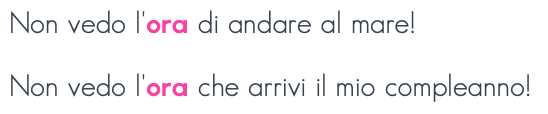
 is also used to say that it is time to do something, right now, at this moment:

And let’s not forget the common expression for impatience or anxious anticipation
Tempo
 is used to describe the abstract idea of time or its passing, as in this commonly used phrase when one is having a great time with someone:

You can also use for ask if anyone has free time, such as:
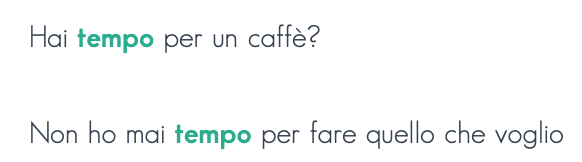
It is also used to indicate a moment , period when something has or has not happened:

❗️ But be careful, it can also mean the weather 🌤️, so when you ask:

You are asking what the weather is like, whether it is bello o brutto (good or bad).
(Here is the article where I explain in detail the difference between “good” and “buono, bravo e bene”).
Volta
Finally, we have . This word is used to indicate the periodicity of something (once, 2, 3 times a week):

Or with these (many times, few times, sometimes):
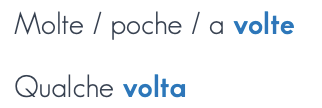
To describe a gradual process as in a recipe:

Finally, the expression is used to begin a fable:

Here we are at the end! I hope now the difference between, e is clearer, if you have any other questions want to put this or anything else into practice, please do not hesitate to contact me or book a lezione di prova (trial lesson)!
PDF Summary table & Exercises
I often read interesting articles that I already know I would like to re-read later and after a few days, so I print it out or put it on my Ipad because I find it inconvenient to read on the computer. If maybe you do too, I’ll leave you the PDF Summary Table of this article and a couple of exercises (with solutions), in case you want to put the “essere” and “stare” into practice a bit.
Alla prossima! 👋

 Dillo in Italiano