
If you want to change language to the article click on “Select your language” on the right side of the screen if you’re on desktop or at the bottom of the page if you’re on tablet or mobile.
Ciao! 👋
Today I’d like to talk about something fundamental to stop getting determinative and indeterminative articles wrong. For many beginning students it may seem difficult to handle, but it is actually one of the few Italian rules with no exceptions.😜
Let’s get started!
Articoli determinativi
The determinative article precedes the noun or adjective and indicates something or someone well defined. It is never used:
❍ with cities (except L’Aquila, La Spezia, Il Cairo, La Mecca and L’Avana)
❍ with proper names of persons
❍ with titles referring to person in direct dialogue:

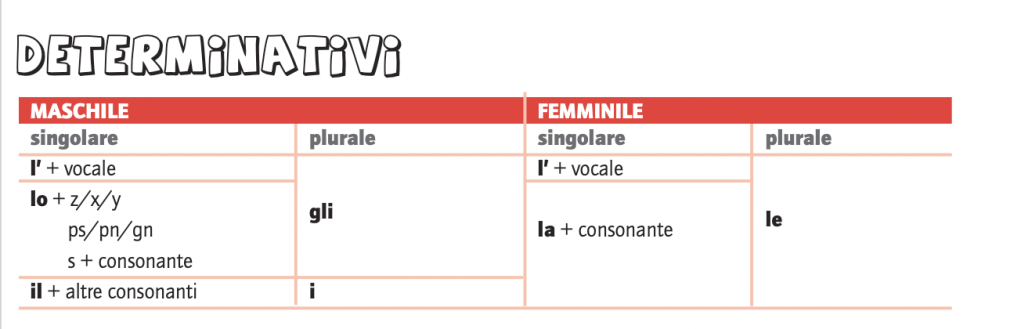
The feminine singular determinative article has two forms:
❍  if the following word begins with a vowel:

❍  if the following word begins with a consonant:

The plural feminine is always  :
:

The masculine singular has three forms:
❍ if the following word begins with a vowel (like the feminine):

❍  If the following word begins with s+consonant, z, x, y, ps, pn, gn:

❍  If the following word begins with the other consonants:

The masculine plural has two forms:
❍  If the following word begins with s+consonant, z, x, y, ps, pn, gn:

❍  in all other cases:

Articoli indeterminativi

The indefinite articlee precedes the noun or adjective and indicates something or someone undefined.
Thus, has only the singular form; for the plural, is used the partitive article .
The feminine singular has two forms:
❍  whether the following word begins with a vowel (it has an apostrophe to distinguish it from the masculine form that we will see in a moment):

❍  If the following word begins with a consonant:

The feminine plural is always the partitive  :
:

The masculine singular has two forms:
❍  If the following word begins with s+consonant, z, x, y, ps, pn, gn:

❍  (without apostrophe) if the following word begins with the other consonants or a vowel:

The plural masculine has the partitive forms:
❍  If the following word begins with s+consonant, z, x, y, ps, pn, gn

❍  in all other cases:

Summary PDF
To make you understand the rule even better I leave you a summary diagram of the rule, if you don’t like the list mode
Esercizi
If you feel like memorizing these rules better, here are some free resources from the web!
http://www.impariamoitaliano.com/uso_degli_articoli.htm
https://www.adgblog.it/2010/10/23/esercizio-per-principianti-il-menu/
A presto! 👋

 Dillo in Italiano